Green Gift Ideas

Reusable veggie bags

Way to upcycle: bulk-food bags made from fabric scraps.

What to give a low-carbon girl on her birthday? That’s what some of my friends were thinking about this year and several came up with some pretty crafty solutions.

Upcycle, Reuse, Repeat
As you probably know, plastic has become the bane of our ecosystem these days. Reducing our use of plastic bags in grocery stores for bulk foods is a great place to start.

To that end, Joy, came up with a very green solution. She took fabric scraps from clothes she had made and created bulk-food bags in every possible size and bursting with color (upcycle!). Then she put them all in a shoebox (reuse!). Too bad you can’t see the wordplay on the shoebox (Material Girl).

Upcycle, Enable, Enjoy
Who doesn’t like to support an artist or small business when ever possible? My friend Nicola sent me a bracelet made of recycled leather and metal from a young artist in Manolates, Greece. And, what girl doesn’t enjoy a little jewelry every now and then?

Experience Only
A few winters ago, Colin Beavan (a.k.a. No Impact Man) wrote an article for YES! Magazine entitled Christmas with No Presents?  In it he talks about ways of giving sustainably and suggests giving experiences, such as dinner out or theater tickets versus purchasing stuff.

So, there you have it, three ideas for the greenies in your life. Or, maybe everyone?

Follow-up: If you have your own bulk food bags or containers, you can ask to have them weighed before you fill them so that you’re not paying for the weight of your bag/container.

Posted in At Home, Green Ideas, My CO2 Footprint, Recycling, Shopping | Tagged , , , , , , , , , , , , , | 1 Comment

Water Instead of Soda

bottled water

The production of plastic water bottles uses more than 17 million barrels of oil annually.

Drink water instead of soda. It’s good for you and the environment. But, what if I said, drink bottled water instead of soda?

Two nights ago I saw a TV ad which made me cringe. The message was that if soda drinkers replaced just one can of soda with a bottle of water a day it would help them lose weight. Huh. This makes me crazy because drinking water is good advice. But, drinking bottled water is NOT good advice.

Our bodies need water, so if you’re on a five-soda-day-habit, replacing one of those sodas with water would probably reduce your calorie intake, hydrate you, and give your bodily functions a better chance to operate properly. However, if you’re just replacing an aluminum can (I instantly think of Chris Jordan’s Running the Numbers image which depicts 106,000 aluminum cans, the number used in the US every THIRTY SECONDS) with a plastic bottle  (a Chris Jordan image depicting TWO MILLION plastic beverage bottles, the number used in the US every FIVE MINUTES)  you’re not helping the environment, not one little bit.

Not Just Any Water: Tap Water

When I see cases of bottled water sitting in someone’s garage I think: Madison Ave has won. Bottled water can cost anywhere from 240 to 10,000 times more than tap water, which is pennies a gallon.

And, it’s not just the cost:

What two words can make all of these issues go away: tap water.

Now, I know there are some places, such as an airport, or in third-world countries where bottle water is necessary, but in many instances of everyday life it is not. Tap water saves money, is on par or sometimes better than bottled water, does not create much in the way of CO2 emissions, or use fossil fuels, or clog landfills.

How Do the Carbon Emissions Pencil Out?

You knew it would come to this.

Bottled Water is more than 1,000 times more carbon intensive than its tap alternative.*

If there are 160 grams per 16 oz bottle of greenhouse gasses generated (CO2, methane and nitrous oxide)* and 128 oz in a gallon (8 x 16 ounce=gallon) then 160 grams x 8 equal 1,280 grams of greenhouse gasses per gallon, so annually, 1,280 grams of greenhouse gasses per gallon multiplied by 30.8 gallons (average amount of bottled water consumed per person in 2012) = 39,424 grams (86.9 pounds!) of greenhouse gasses per year per person.

Tap Water is not a major carbon concern for most North Americans.*

For every 16 oz of tap water .12 grams of greenhouse gasses are generated.* .12 grams x 8 equal  .96 grams of greenhouse gasses per gallon, so annually, .96 grams/gallon multiplied by 30.8 gallons = 29.6 grams (0.065 pound) of greenhouse gasses per year per person. Not even a pound. Nice. Much more sustainable.

* How Bad are Bananas? The Carbon Footprint of Everything by Mike Berners-Lee
 

Can We Get Off the Bottle?

BevNet:  “A new report from the International Bottled Water Association (IBWA) states that in 2012, overall consumption of bottled water jumped by 6.2 percent to 9.67 billion gallons, while sales increased by 6.7 percent, totaling $11.8 billion. The statistics were compiled by beverage consulting firm Beverage Marketing Corporation (BMC).

With every American consumer drinking an average of 30.8 gallons of bottled water last year, the report stated that per-capita consumption of bottled water was up 5.3 percent in 2012, and that the beverage increased in absolute volume more than any other beverage category in the U.S.”

ScienceBlogs: “The vast increase in bottled water sales have largely come at the expense of tap water, not soft drinks. And even if we pushed (as we should) to replace carbonated soft drinks with water, it should be tap water, not expensive bottled water.”

Based on those two quotes above, bottled water is here to stay. But, only because people are willing to pay through-the-nose for convenience and, I guess, aren’t thinking of the consequences (draining fossil fuel supplies, clogging landfills and whatnot).  Is filling a reusable container with tap water really that inconvenient when you look the environmental consequences of bottled water?

Posted in Food, My CO2 Footprint, Saving Money | Tagged , , , , , , , | 12 Comments

Interview with Sprout Energy Corp Founder: Wind Power

Jennette's Pier, Nags Head, NC

Bergey Excel-S wind turbines at Jennette’s Pier in Nags Head, NC.

I caught up with Sprout Energy Corp founder, Claiborne Yarbrough, a couple days ago, at environmentally-friendly Jennette’s Pier in Nags Head, NC for a quick interview about wind power.

Here is a transcript of our brief interview (link to my questionable YouTube effort):

LCG: Low Carbon Girl here leaning in today with Claiborne Yarbrough founder of Sprout Energy Corp at Jennette’s Pier in Nags Head, NC where the wind is 10 mph WSW to discuss wind power.

How does wind power compare to other  renewable energy options such as solar, hydro or geothermal?

Claiborne: Wind power a great source of alternative energy. It is the sexiest because it is the most visible. And, definitely, at Jennette’s Pier with three turbines at 120 feet engages people as they are able to walk under them and actually fish. However, I will say that wind energy is completely reliant on a constant wind source. This is something that has to be placed in particular areas so that the power generation can be as much as possible and that differentiates it from the other renewable energy sources.

LCG: There’s plenty of wind here, right? Today we have gusts between 7-14 mph.

Claiborne: This is one of the things we started to think about with Sprout. This is what we wanted people to be able to understand, to not only see renewable energy sources but to also understand how much power was being produced by the amount of sunshine and amount of wind. What you start to understand about wind, is that even though these Bergies out here, for example, have 10mph of consistent wind they are not producing as much energy as you might expect. With wind energy there is a bell curve, because at some point there is too much wind and it’ll shut itself down. [More wind isn’t necessarily better, consistent wind produces the most energy.] It’s all about the rotors. The rotors are creating electricity and if it’s going to fast it’s not able to generate electricity. So, again, siting of wind turbines is incredibly important. What I think what some people want to do is just throw up a wind turbine, but I’m not talking about people in the Midwest who have used turbines for hundreds of years to operate wells and provide water for livestock, or something like that. To truly offset of this size [9,000-square foot pier house], you really have to have a consistent wind source. I’m not saying they’re not doing some of that, it’s just misleading in a way.

LCG: Right, on their website they mentioned that at maximum capacity the three wind turbines generate about half of the electricity needed for the building.

Claiborne: Yes, just a little over half. I was looking at yesterday’s data and it looked like a 1,800 kwh of electricity were consumed. And, about 80 kwhs of electricity were produced by the wind turbines and solar panels. It was pretty windy yesterday.

LCG: Their website mentions that the solar panels light their walkways.

Claiborne: Yes, and that’s a great application for solar. We’ll get into that some other time.

LCG: OK. Most people assume the best place for wind turbines is in the windiest location, but what do you think of the University of Washington’s Conservation magazine’s assessment that CO2 emissions would fall the most in the Midwest, which currently relies heavily on coal-fired generators? [In contrast, California saw a relatively small drop in emissions, partly because the state already uses gas-fired plants.]

Claiborne: I think that, again, this is much larger issue. In terms of wind energy, as long as the wind source is consistent then it makes some sense. But, always the bigger picture is CO2 emissions. I would say in the Midwest unless you’re up on a range, or up on top of a mountain it really doesn’t make much sense to have wind applications or wind farms, you’d be better off, better served and it would cost less money to service a solar farm.

LCG: Where do you think wind power is today?

Claiborne: I think wind power is still in its infancy. I know a lot people think it’s a failed business model but, in fact, the recovery act money that went to wind really wasn’t significant. What is driving wind energy is a market-based economy. There are some smaller wind turbines that are very appropriate for coastal businesses and homes, like the Windspire, but a lot of these businesses are coming up with technology then going out of business. So it’s very volatile. Definitely something to keep your eye on. But, a better thing to do is use a more reliable resource like solar power. Hopefully with solar power, wind energy and these alternative energies its really more just getting people to think about these things and change their consumption habits.

Sprout Energy cap

Sprout Energy. Changing the way you think about renewable energy. Swag 🙂

Posted in Alternative Energy | Tagged , , , , , , , , , , , , | Comments Off on Interview with Sprout Energy Corp Founder: Wind Power

Let Them Eat Fries!

Atlantic David H. Freedman, How Junk Food Can End Obesity

The Atlantic’s article: How Junk Food Can End Obesity. Marginalia could not be contained.

I just read The Atlantic’s article How Junk Food Can End Obesity by David H. Freedman. I don’t know if The Atlantic was trying to stir up controversy or check readership, but the article freaked me out.

And, I’m not alone. SalonGrist,  and Mother Jones  are shocked as well. Freedman posted early responses to his article.

So, let me get this straight, “…many of Big Food’s most popular products are loaded with appalling amounts of fat and sugar and other problem carbs (as well as salt), and a plentitude of these ingredients, exacerbated by large portion sizes, has clearly helped foment the obesity crisis.”  However, instead of suggesting that people stop eating processed foods or at fast-food restaurants every meal and cook at home Freedman is suggesting that the “wholesome-food advocates” stop pressing Big Food for healthier options. This would allow Big Food to quietly reduce the calorie/fat content while still maintaining the fat-laden mouth-feel? What? Is this to keep obese people alive a little bit longer so that Big Food can sell more product?

Two main messages in the 13-page article are:

  1. We have to modify junk/fast food because “people aren’t going to change their ingrained, neurobiologically supercharged junk-eating habits .” Overweight or obese people “won’t eat broccoli instead of French fries.” Wow. Maybe Michael Moss was right – junk/fast food is addictive.
  2. Only affluent and well educated people take responsibility for what they eat. Overweight/obese people are usually poor and live in food deserts where grocery stores with fruits and vegetables rarely exist. And, even if fresh produce was available, overweight people are unwilling or too uninformed to change their eating habits.

It seems the author completely misses the point of Michael Moss’s NY Times article based on his book, Salt Sugar Fat: How the Food Giants Hooked Us.  It’s not about trading inexpensive fast food for high-end Whole Foods packaged Vegan Cheesy Salad Booster – NO! – it’s about buying actual fruits, vegetables and other whole foods and making meals at home.  That’s a skill America as a whole has lost and it’s not a skill that is accessible only to the elite (people who read the NY Times and shop at Whole Foods).

However, the most chilling paragraph was: “By all means, let’s protect the environment. But let’s not rule out the possibility of technologically enabled improvements to our diet – indeed, let’s not rule out any food – merely because we are pleased by images of pastoral family farms. Let’s first pick the foods that can most plausibly make us healthier, all things considered, and THEN [emphasis mine] figure out how to make them environmentally friendly.” EEK. I heard bee colonies collapsing when I read that.  Pesticides or genetically modified organisms, anyone?

We’re reading The Atlantic, OK? Now, stop freaking us out!

Posted in Food | Tagged , , , , , , , , , , , , , , , , , | Comments Off on Let Them Eat Fries!

Sustainable Travel

travel, luggageThere’s an oxymoron.  And, yet, I’m sure you’ve seen ads for sustainable travel or green travel or eco-something-or-other.

Travel by its very nature increases your carbon footprint unless you’re walking and even then it would be best if you were fueled by plants instead of meat or dairy* and wore secondhand clothing.** I know mind-bending, right?

That’s one of the reasons I like Do the Green Thing’s approach. They’ve identified seven lifestyle changes anyone who would like to reduce their carbon footprint can make without going into a carbon-footprint calculation spiral. Two of their recommendations involve travel:

So, when I wanted to visit my Mom in PA for her 83rd birthday, clearly, walking from NC to PA wasn’t an option, but maybe driving would be better than flying. I’m not a big fan of flying anyway plus there is an hour or more drive getting to and from the airport. Let’s compare:

Trip A – Car Rental – Actual Trip
I rented a Hyundai from Enterprise. When I signed up online there was an option to buy a Greenhouse Gas Emissions Offset for $1.25, so I did. Enterprise’s info blurb about it says that it will offset the gas emissions generated by an average rental vehicle. The money goes to TerraPass to fund certified offset projects that remove carbon from the atmosphere. And, Enterprise will match customer contributions dollar-for-dollar up to $1 million. Wow.

The trip is approximately 380 miles. I used one tank of gas each way. Only $66 out of pocket, plus I got to see a little bit of the country. I discovered SaladWorks and saw the Sustainable Brands building without realizing they are one of the organizations I follow on Twitter. They have a leaf in their logo, which is what caught my eye. I later connected the dots when I saw one of their posts in my 2-D world. Here’s how my drive tallied up:

  • 235.4 lbs CO2 as calculated by TerraPass to drive 400 miles in a 2012 Hyundai Elantra (without an offset)
  • Rental cost plus gas: $236
  • It took me 8 hrs door to door.

Trip B – Air Travel – Proposed Trip
First, there is the ride from my husband to the Norfolk, VA airport, which is three hours roundtrip for him. Or, I could hire a cab service. Then there is TSA (I’m sure they’re adding to my carbon footprint somehow) and the flight. Then, either my mom picks me up for a total two-hour roundtrip drive or I hire a car service from the Allentown airport. (I would have hired a service in both cases.)

I’d have to leave NC at 7am in the morning to get at the airport an hour before my flight. There aren’t any direct flights so I’m looking at 9:30am-1:30pm of air travel time then another hour of drive time after I land. Here’s how my airplane travel would have tallied up:

  • 786 lbs CO2 as calculated by TerraPass for a flight from Norfolk, VA to Allentown, PA with one stop. That number does not include any car travel.
  • Airfare through Expedia and car service costs: $762
  • Total hours door to door: 7.5 hrs – only half an hour saved – and that’s if everything runs smoothly.

So, that’s a bit of an eye-opener, eh? A plane wouldn’t have saved that much time and would have cost a lot more. By driving, I avoided all of the airline hassle/tension and saw a little of the country, plus the Chesapeake Bay Bridge-Tunnel is totally fun.

There you have it. Picking the smallest carbon-footprint travel option saved money, didn’t take much more time and was fun.

* The carbon footprint of two pints of milk a day is 1.160 lbs of greenhouse gas a year, as much as a return flight from San Francisco to Vancouver. (And, we’re not even looking at your cheese, yogurt or ice cream intake.) How Bad Are Bananas? By Mike Berners-Lee

** “After food, the most important source of indirect personal CO2 emissions is probably clothing.” How to Live a Low-Carbon Life by Chris Goodall.


Posted in Travel | Tagged , , , , , , , , , , , , , , , , , , , , , , | 5 Comments

Could Weeding be the Next Big Status Symbol?

Weeding my driveway instead of using chemical weed killers.

Weeding my driveway instead of using chemical weed killers.

I wonder. It seems that everything old is new again, doesn’t it? Not that weeding was ever a status-symbol activity, but green lifestyle choices such weeding instead of using chemicals are gaining momentum (thankfully!).

One place we need to be especially careful is at the shore, near a river or stream, or any body of water. Yup, I’m talking about your vacation house.

Fertilizers and weed-killing chemicals used in landscaping can adversely affect nearshore waters and marine life. You don’t have to be a marine biologist to understand that anything applied to landscaping abutting a body of water will soak into the soil and potentially run off into the water.

Nutrients from fertilizers can over stimulate algae growth, which in turn consume the dissolved oxygen fish and aquatic invertebrates need to live. And, here’s the kicker, even if it doesn’t seem to matter right away, eventually it’ll inversely affect fishing and recreation. Besides, who wants to eat even slightly toxic crabs or fish? Not me.

The EPA has a few guidelines for nearshore home owners:

  • Reduce the use of pesticides and herbicides.
  • Consider selecting plants and grasses with low maintenance requirements.
  • Water your lawn conservatively; the less water you use, the less runoff will eventually find its way into nearshore waters.
  • Preserve existing trees and plant new trees and shrubs to help prevent erosion and promote infiltration of water into the soil.
  • Restore bare patches in your lawn to prevent erosion.

All of this finds me weeding our 40-yard gravel driveway on the outer banks — our house is a mere 40 feet from the water. That is closer than a hiker is even allowed to pee near a stream in the wild.

If you use a landscaping service at your home, whether it’s on the water or not, why not inquire about hand weeding? It may be a tad more time-consuming and/or expensive, but it’s the greenest way to go. The hard part is going to be working all your green goodness into the next dinner party conversation.

Posted in At Home, Travel | Tagged , , , , , , , , , , , , , , , , , , , , , , , | Comments Off on Could Weeding be the Next Big Status Symbol?

How Green is Your Clean?

cleaning products

How green is your clean?

Is someone decorating Easter eggs or is that your green cleaner?

You know what I’m taking about, right? It’s the green cleaning combo of baking soda and white vinegar.

Why green cleaners? If you’re like me, you’ve been trying to overhaul your cleaning products so that they are less harmful to your household as well as the environment.

What I’ve noticed as I get rid of each spray & wipe cleaner and replace it with an earth-friendly variety, it takes more elbow grease and time to use, so I remind myself that it costs less and I’m burning calories as I reduce global toxins. (Yup, I like to think big – keeps me motivated.)

USA Today’s Green Living magazine puts baking soda and vinegar in the lineup of green cleaning essentials: baking soda (great for scrubbing bathtubs and deodorizing carpets), lemon juice, white vinegar, club soda and borax (sounds like the 1950’s, right?). Progress has made cleaning faster and more toxic. Seems like we should just revert back to the Mad Men era, right?

Rate Your Cleaners
Maybe. There are a lot of so-called green cleaners on the market that try to bridge the gap (fast-working/less toxic). Are you curious how green your cleaners really are? I am. Let’s use Environmental Working Group’s (EWG’s) Guide to Healthy Cleaning Guide and see how my current store-bought cleaning products stack up. Maybe you use some of the same cleaners, if not, just peruse their guide to see how your cleaners rate.

Kitchen

Bathroom

Floors

  • Murphy Oil Soap – I thought this would fair better. Get’s a C.
  • Mop & Glow (I used to use Bona, but it just didn’t work!) Ok. I kind of expected this one to fail ‘cause it leaves my floors nice and shiny and a little water-resistant. It got an F.
  • Bona mop with washable terry cloths.

I’m a little disheartened after getting my cleaning-product report card. I hope your cleaning products did a bit better. Good to know though. I’m going to go through EWG’s website and pick out some products at the front of the class to replace my C-F store-bought cleaners.

Stop Dirt in Its Tracks!
Of course, I try to prevent dirt from coming into the house. This is a neat trick I learned since moving to the Northwest where there is a six-month mud season. People take their shoes off upon entering a home. Seems simple enough, but I was horrified at first as few people offer surrogate indoor shoes. (EcoExpert does a great job of discussing this very topic.)  Now, years later, like many NWers I take slippers or indoor shoes with me so my feet stay toasty without tracking in dirt.

Follow Up
Here are some general things to keep in mind when considering a cleaner, from Green Living magazine:

  • Look for products with a USDA organic seal.
  • Avoid products that instruct you to open windows or use ventilation during use, which is an indication that toxic chemicals are being released.
  • Avoid petroleum-based products and dish washing detergents with phosphates, which are not earth-friendly.


Posted in At Home, Green Ideas, Saving Money | Tagged , , , , , , , , , , , , , , , , , , , , , , , | 5 Comments

Look at That! You Can Have it All!

Tapioca bag

Sustainable bag made from tapioca by Ecopia – great biodegradeable alternative to plastic or paper.

At first, I thought Sanuk*  (the sandal company) was going to be my new favorite company, not for their products, but for the biodegradable bags they use to package their products. Their bags are made of corn or tapioca. (If you’ve read any of my blog, you know what I think about plastic.)

The tapioca bags are made by Ecopia.  They seem fairly new to social media (I was the 36th LIKE on their FaceBook page). So, show them some love and run right on over there and LIKE their page.

“Ecopia offers the world’s best alternative to paper and plastic. Simply put, better products for a better planet!” Plus, they believe in fair-wage jobs for Indonesian farmers – wow. A win-win-win. Love those.

The nice thing about a biodegradable/compostable bag is that once you’re done reusing it, you can fill it up with vegetable scraps and toss it into your compost bin.

Bonus: “tapioca is a food source for common microorganisms found in oceans, lakes and soil, once in contact with microbial activity, the material is consumed until it is gone.”

So, there you have it (all). The convenience of bags without the crushing guilt or long-term litter/pollution. Thank you tapioca and Ecopia.

*Sanuk makes hip beach/surfer sandals, which were originally constructed from inner tubes and carpet.

Posted in Green Ideas, My CO2 Footprint, Recycling, Shopping | Tagged , , , , , , , , , , , , , , , , , , , , , , | 3 Comments

Making Mistakes at the Grocery Store so You Don’t Have To

reusable container

How to prep reusable containers for the grocery store.

OK, so the majority of us, I’ve noticed, have managed to make the transition from going to the grocery store empty-handed to bringing re-usable grocery bags. Good. We can check that off of our low-carbon/earth-friendly lists.

Now, it’s time for the next step. And it can be a doozy!

One of the things that really impressed me about Colin Beavan’s (aka No-Impact Man) yearlong experiment was that he produced very little waste. I knew that meant taking containers to the grocery store, but how does that work exactly, I wondered? Thoughts of clanging to the store with glass jars and empty tins seemed a little repellent.

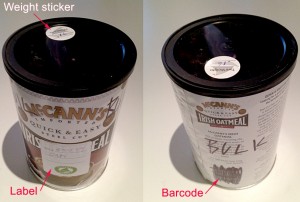
Thankfully, an opportunity presented itself. I eat a lot of oatmeal and keep all of the tins to reuse, which have been stacking up at an alarming rate. Then I found out that our store offers steel-cut oats in bulk. I could see a faint connection forming.

Here’s the reuse tip: although stores don’t seem to promote this service at all you can take your old containers to a clerk and they’ll weigh them and put a little sticker on them so that amount can be subtracted from the overall weight during checkout.

I was thrilled. I had my reusable mesh bags for my veggies (some produce just roamed free in my cart) and now I had my tagged oatmeal tin. I wheeled to the checkout counter with a song in my heart, unaware of any potential pitfalls.

Avoid this mistake: the clerk trudged through identifying all of the vegetables in mesh bags and weighed all of the loose fruit, but scanned my old tin. I had labeled the tin and it had a weight sticker, but I had forgotten to cross off the bar code. Oops! I paid a premium for the bulk oats.

Lesson learned. The barcode has since been scribbled out. Now, my reusable tin is armed for the next trip to the store. Is anyone else taking reusable containers to the grocery store?

Posted in Food, Recycling, Shopping | Tagged , , , , , , , , , , | 2 Comments

What About a Composting Toilet?

rural cabin

Off the grid in my mind’s eye.

Last week I ran into a colleague on the ferry and we spent the half an hour trip talking about how he has gone OFF THE GRID. Yes, that’s right. Armageddon could hit tomorrow and he and his wife would still have power and water. It would not even put a blip in their day because they’re not plugged into the system.

So many questions ran to the forefront of my brain that it jammed and I just stared at him in shock. “So, you’re a survivalist?” I managed to ask.  No, he and his wife had found an island where they wanted to live and it didn’t have any utilities, so he “did some research” and learned how to:

  • Capture water from their metal roof, store it under their house in huge barrels filtering it down to a micron it so that it’s potable (removing any giardia). He also had to secure water rights. (I didn’t realize but people aren’t allowed to collect rainwater and use it. I guess we can’t be trusted to not poison ourselves.)
  • Convert all AC power to DC because it takes fewer AMP’s to run electronics.
  • Store electricity from their solar panels in a battery bank.
  • Install a composting toilet in their house – yes, like the ones you see in parks. Human waste, woodchips, repeat – no toilet bowl cleaner needed. They selected a Clivus Multrum. I think they went with the trailhead version.
  • Install LED lights throughout their entire house.
  • Reduce their laundry power usage to 9 AMPs per load. (They line-dry their clothes, of course.)
  • Reduce their refrigerator power usage.
  • Reduce their total ANNUAL power usage to 250 kwh – amazing.
  • Still live comfortably, running as many lights and computers as they want.

My friend, who asked to remain nameless, said he’d never go back to a regular toilet again. I was taken aback but tried to remain low-carbon-girl cool. “Really? “I don’t like that our toilets use potable water, but what if we could do what Australia does and run two lines?” I asked. “One potable for sinks/showers and one for gray water for toilets.” No, apparently, low-use composting toilets don’t smell and require only yearly maintenance.* Hmmm!

Here’s the rub. Americans like things easy.**  Quite a few of us make buckets of money and we’re ready to spend it. We are like dieters who think we can eat diet cake and loose weight (tip: don’t eat cake). We want clean air and water but we still want to use all the fun stuff we created. OK, I get that. So, here are two easy tips from my friend:

  1. Buy an LG washer without the preheat element. Sounds so simple. And, it is. Most of us run cold-water washes these days (detergents are doing a better job of cleaning with cold water) anyway, but apparently, even if you don’t use warm/hot water the preheat element uses power. So, there you go – get your laundry down to 9amps a load. And, then, if possible, line-dry your clothes. Second part is a little harder, but I thought I’d throw it out there in case you were feeling ambitious.
  2. Buy a German Steca refrigerator.  As you probably know, cold air sinks, so it takes less energy to power a refrigerator with a lid versus the French-door type we’ve gotten used to with all of the brightly-lit shelves. They don’t take up much space either.

Refrigerators and washer/driers are the biggest energy consumers in our homes, followed quickly by large flat-screen TVs. When looking to buy your next appliance, look for an Energy Star rating at the very least.

* There is even an office building in Seattle that uses composting toilets and has a net-zero footprint – The Bullitt Center. Their energy and water bills are zero – image that!   Solar panels generate all the electricity they need – in Seattle no less!

** How could one person’s actions have any impact on the environment at all?  Some people might be confused by their role in climate change.   If you’d like to help people who seem confused, or are put off by seriousness of climate change, then consider backing a cartoon book on climate change – we need to keep this fun!

Posted in Alternative Energy, At Home, Green Friends, Green Ideas | Tagged , , , , , , , , , , , , , , , , , , , , , , , , , , , | Comments Off on What About a Composting Toilet?