Shout out to the Greenpeace Guys

Greenpeace

Todd and Peter from Greenpeace.

Greenpeace is canvasing Bainbridge Island today (yesterday was Port Townsend, where they signed up 59 people – come on BI – don’t let PT beat us!). To the left is a picture of Todd, me and Peter who caught me as I was racing to T&C. They were standing in the FREEZING cold rain without even a shred of Gortex. Uhm. Seattle=Gortex.

Small aside, before I moved to Seattle, I was biking in New Zealand and overheard someone griping about the quality of the coffee. I was shocked. Really? You’re in an extremely beautiful place and all you can think about is that bad cup o’ Joe you had in the morning? But, that was before I moved to Seattle and got addicted to coffee. In fact, Diana Mucci, the woman complaining, happened to not only live in Seattle but had her own coffee stand on the corner of 2nd and Columbia. She was the only person I knew before moving to Seattle, got me addicted to coffee, by feeding me the local baby formula (double tall mocha) and told me the weather’s not an issue if you dress for it (Gortex and fleece). I don’t see Diana much anymore but she had a huge positive impact on my life. I’m warm and alert.

Getting back to Todd and Peter,  I’m surprised they weren’t recipients of a little more BI hospitality (you know a coffee, or something). But, it is a busy time of the year and I almost whisked past them myself.

I know I’ve donated to Greenpeace before, but not sure I’ve ever been a member. Todd and Peter were happy to be blog-fodder in exchange for a membership, so I signed up. See the trouble this blog is getting me into?

The main issue Todd and Peter were concerned about today was coal. I sure hope Greenpeace’s site is on a carbon-neutral server, like mine – AISO 100% solar powered. Remember, most hosting companies use diesel generators as backup. Eek.

Good luck guys. Help us save the planet.

Posted in Alternative Energy, Green Servers | Tagged , , , , | Comments Off on Shout out to the Greenpeace Guys

A Quick Word About Christmas

Christmas can be a tricky time, I’m realizing, for those of us trying to reduce our carbon footprint while not appearing to be a total humbug. Here are a few tips:

Christmas Trees
Ok, so by now, you’ve probably purchased and decorated your Christmas tree, but, if you’re frozen between the choice of a fake or real tree and wondering which way to go, The Nature Conservancy offers their recommendation: real trees. Shocked? Click on the link above to see why cutting down a real tree is better carbon-wise than buying a fake one. And, for all of you with a fragrant real tree in your living rooms you can breath a sigh of relief, preferably, on a living tree that can absorb your CO2.

Christmas Gifts
New York City’s No-Impact-Man Colin Beavan wrote an article on Christmas gift giving in Bainbridge Island’s very own YES! Magazine. It’s a thoughtful piece about how to give sustainable gifts to people who still want/expect gifts even though you might not give gifts within your own family.

And, should you find yourself actually purchasing gifts to give, The Nature Conservancy has tons of DIY ideas on their blog using recycled elements and making them beautiful, like the bow pictured to the left.

If you’re looking to create a gift, or upcycle something lying around the house, Upcyclista has great ideas on their FaceBook page, such as making gift tags out of used maps.

Reusable Gift BagsOh, and I almost forgot! Reusable gift bags. They aren’t mentioned too much these days, but for those of you with a sewing machine out there, it’s just a bag stitched on three sides with an attached tie cord. See samples left. (We got these years ago when ordering clothes, from some company way ahead of its time. I just found them tucked way waiting for the perfect opportunity, but why wait? I’m using them today.)
 

Posted in My CO2 Footprint | Tagged , , , , , , , , , , , , , , , , , | 2 Comments

What Lifestyle Changes Have the Biggest CO2 Impact?

Joy brought up another good question while we were having lunch the other day: if a person wanted to reduce their carbon footprint, what change would have the most impact?

Most resources agree that reducing motorized travel of any kind would have the biggest impact on overall carbon emissions reduction. Chris Goodall puts a finer point on the matter in his book How to Live a Low-Carbon Life by saying “the only really significant change to our lifestyle that we need to make to get our carbon emissions significantly lower is to cease to travel by air.” Wow. Cease. Cannot imagine a world without any air travel. I could see it significantly reduced, but ceased? Eek.

Let’s take a 3,000 ft look at what Chris Goodall outlines as the most critical changes a person can make, then let’s look at some CO2 calculators and see where I end up, carbon-wise.

What can you do to reduce your CO2 output now?

  • Cease air travel (ouch!)
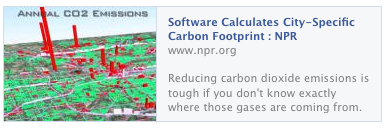
  • Drive your car less. (No need to rush out and by a hybrid. Producing cars produces CO2, so hold on to that clunker as long as possible – a little counter intuitive, but it works for me.) Small aside. If you need motivation to drive less, take a look at the Hestia project where scientists put CO2 probes all over a city to measure street and building emissions – the landscape actually breathes with CO2. Hestia Project measures city-specific CO2 emissions
  • Food. “Buy organic when possible, local when available, keep away from processed and packaged food, and most important of all, buy less meat and dairy products.” Wow. Less meat and dairy – that’s what America runs on. Apparently, “the energy used to provide food to our tables is nine times greater than the caloric value of the food itself.”
  • Use trains and long-haul buses. City buses stop and start a lot which apparently wipes out some of their efficiency and rural country buses that run almost empty aren’t doing much either.
  • Turn your heat down, to 65F/18C degrees, if you can. We have ours set at 68F/20C and it seems chilly enough. (I’m wearing two sweaters as I type this.) We turn it down to 55F at night – get points for turning heat down at night. Warmer climates need to consider their air-conditioning use as well.
  • Household appliances that use the most energy are: clothes dryer, refrigerator and washing machine. Next inline is that large flat-screen TV, not a big surprise.
  • Keep things longer. I’m down with this concept. It costs more in CO2 emissions to make new computers and cell phones than to upgrade to a more energy-efficient models.
  • Buy used clothing whenever possible.
  • Basically, consume less material things. As a non-shopper, that sounds good to me!

Those are the broad strokes from Chris Goodall’s book. Next, I’ll look at some carbon-calculator results.

Posted in Conservation, Food, My CO2 Footprint, Travel | Tagged , , , , , , , , , , , , , , , , , , , | 2 Comments

Eco-Shopping What’s a Girl to do?

Buying local clothing is NOT the same as buying local produce. There is a trend to buy locally, which on the whole is a good thing for the local economy, but most clothes, and raw materials to produce those clothes are not local. Far from it. Looking at my modest wardrobe and reading just a few tags I can see my sweaters, shirts and pants are far from their homeland of China, Peru, Hong Kong, and even Mauritius, an Indian Ocean island. Yikes.

What’s a girl to do? Thankfully, there is an easy answer. Whew. Buy used clothing. Did I hear an “eww”?

First of all there are some fun new businesses featuring upcycled clothes and products. One of my favorites is Pantaluna which features super stylish clothes made from recycled t-shirts. Super soft. They have an online store, but if you happen to be in Frenchtown, NJ, its so worth the visit. The business is owned by family friend (my parents know her parents) and uber talented artist, Illia Barger.

Methane-burping sheepSecondly, the CO2 emissions in creating new clothing is a little shocking so if we can keep demand down (and more dollars in our pockets) it’ll go a long way to reduce CO2. For instance, one kilogram of cotton clothing (raw material and manufacturing) has a 30-40 kilogram footprint; wool is the worst offender at 80-90 kilogram footprint for one kilogram of wool. Why is this you might be wondering? Methane-burping sheep (made an animation to illustrate thanks to How-to-Draw-Funny-Cartoons). And, don’t think you’re off the hook if you buy cashmere – goats are burpers of methane too.

So, allow others to assume the carbon-footprint guilt and buy used clothing. Still hesitant? Watch this video: Thrift Shop by Macklemore.

Thrift Stores
Might as well note local stores in your area. There are four on Bainbridge Island, I’m going to try two out today. It’s been a while since I’ve been thrifting – hope it’s not scary!

My thrift store purchase - blue sequined topFollow up: I went to Silver Star Trading Post – not scary at all. I was really surprised at all the fun stuff they had – the place was jam-packed. Not super inexpensive, but I never would have paid full-boat for something as frivolous, so it looks like thrift stores will allow me to take some fashion chances and get me out of boring-safe and into risky-fun. Can never have too much fun.

Second Follow up: You can shop for secondhand clothes on line. Good list from Do the Green Thing.


Posted in Conservation, Recycling, Saving Money, Shopping | Tagged , , , , , , , , , , , , | 1 Comment

Let’s Start with Breakfast

Breakfast of oatmeal, granola, bananas and applesauce

Breakfast of champions – oatmeal, granola, bananas and applesauce.

My new low-carbon self-assessment microscope swings its lens  toward … breakfast!

This is what I have most mornings: oatmeal, applesauce, homemade granola (either mine or from Farm Kitchen in Poulsbo, which is sold locally at Rollingbay Cafe), and bananas. There is probably somewhere to cut some carbon corners, but first a note on why this breakfast.

Last year I found out that I was allergic to eggs, which I used to eat just about every day, dairy and anything with gluten. So, I didn’t arrive at this breakfast combo on a whim and I’ll be hard-pressed to change it. On a positive note, Chris Goodall’s book How to Live a Low-Carbon Life (and remember most reports say we should get down to 2 tonnes or less a year – more on that in a later post) said that “Dairy cows produce over twice as much methane as beef* cattle. Becoming a vegan would very definitely help [reduce  carbon emissions].” Yay for me and my annoying food allergies.

Now, let’s look at each element and see how I’m doing:

  • Oatmeal. I’ve been eating McCann’s Steel-Cut Irish Oatmeal. It’s distributed from Wisconsin, not as far away as Ireland, but I found a California replacement (tad less shipping), Open Nature‘s Steel Cut Oats, and they cost $3 less!  About $78/year in savings. Harder to calculate the carbon savings. I wish food had carbon footprint labeling.
  • Applesauce. From WA – so it stays, although it would probably be better if I made applesauce from my own apples, but seriously, who has time to spend all day food prepping?! Ultimately, that’s what I think we’re up against – a whole lifestyle change if we’re going to really reduce carbon emissions.
  • Bananas. From Guatemala – let’s see what Chris Goodall has to say about bananas. “Anything quickly perishable from outside [the US] brought to your supermarket probably came by air. The key exceptions are likely to be long-lived fruit such as bananas, which are sent by ship [lower emissions than air].” Woohoo! Bananas get to stay.
  • Granola. This is one of the reasons people pretty much want to pass out when trying to calculate the carbon footprint of various foods, each element has to be considered. In this case: oats, cranberries, ginger, apricots, etc. I know that most of those things aren’t grown locally. But, at this point, I’m not willing to give granola up.

As far as breakfast goes, I’m just going to take solace in the fact I don’t drink milk or eat dairy of any kind and not change this meal other than buying my oatmeal from a closer distributor.

* Have to say there are a lot of conflicting reports on eating beef. The movie Carbon Nation recommends eating less (no) meat and associates it with deforestation of rain forests, which I think is a stretch. Deforestation does further warm the earth and there is some due to cattle ranching but there is already a lot of cattle ranching/feed lots that don’t require cutting down rain forests. Two separate topics in my mind: methane produced by beef and reduction of carbon/heat-absorbing rain forests.


Posted in Food, My CO2 Footprint | Tagged , , , , , , , , , , | 1 Comment

It’s all No-Impact Man’s Fault

Have you ever seen a documentary or news story where someone claims some seemingly minor occurrence changed their life? Well, after years of rolling by eyes at other people’s life altering events, it happened to me! I happened upon Colin Beavan’s No Impact Man book, which I read, then his blog,  and finally I watched his documentary and had that life-altering moment. Queue eye roll. I know. But, I was really impressed by the changes he made, mainly the reduction in household waste. So, that’s been thrashing around in my head for over a year.

The idea of a blog kept dogging me, not a year-long project like No Impact Man, but just something to help me look at the world differently and make more conscientious, green choices. I wrestled with the pros and cons. The cons were: more time in front of the computer; and adding to my carbon footprint by having a server somewhere host my blog/email. The pros were: hopefully finding a way to live a lower-carbon emission lifestyle without giving up everything.

Tipping Points

Several people and things gave me a gentle shove forward.

First, I couldn’t find a first-hand account of someone trying to reduce their carbon emissions in the US, I did find Green Steve’s blog (very readable – love the way he looks at both sides of most issues, like buying local food), which is based in the UK. And, although it’s great, it’s not from the viewpoint of an American girl, which I have to say is going to be A LOT different. 🙂

Second, would I have enough fodder for at least a year or more? I mean what if I found out how to reduce my carbon footprint in a few months and be done with it? This is the question my friend and fellow blogger, Joy, who writes a fabulous food blog, posed to me just a few weeks ago. Well, would I?! Green Steve’s blog just celebrated it’s first year, so I figured that was a good indication that I might find enough carbon-footprint related things to research and discuss for a year or so.

Third, I bought How to Live a Low-Carbon Life by Chris Goodall (also from the UK, one might think the UK cares more about reducing carbon emissions than our fabulous US) and wanted to try out some of his suggestions and “talk back” to the book, so to speak, on points of issue.

Here’s a preview of the types of struggles I have reducing my carbon emissions (among other things, I’m addicted to Amazon’s instant gratification)…. I bought How to Live a Low-Carbon Life used from Goodwill in Seattle instead of having it shipped new all the way from the UK and was feeling pretty good about that. BUT I really wanted to read it right away so I bought the e-book from Amazon (think server farms drinking down energy like a thirsty athlete on a hot day). Yikes.

Fourth, I’m volunteering for a number of nonprofits right now, two of which conserve land: Bainbridge Island Land Trust and Great Peninsula Conservancy‘s Kitsap Forest & Bay Project. Hard to work for land-conserving nonprofits and not try to be as green as possible, right?

And, finally, I found a green server (guilt alleviated) – woohoo! It took a little research. There are a handful of hosting companies who buy renewable energy credits, but as my friend Joy says “that’s like phoning it in.” I totally understand that hosting companies can’t just put up a wind turbine farm in the middle of downtown, but I found a hosting company, AISO, that powers their servers with their own solar panels. This blog is on their servers.


Posted in Green Servers, My CO2 Footprint | Tagged , , , , , , , , , , , , , , | 2 Comments